







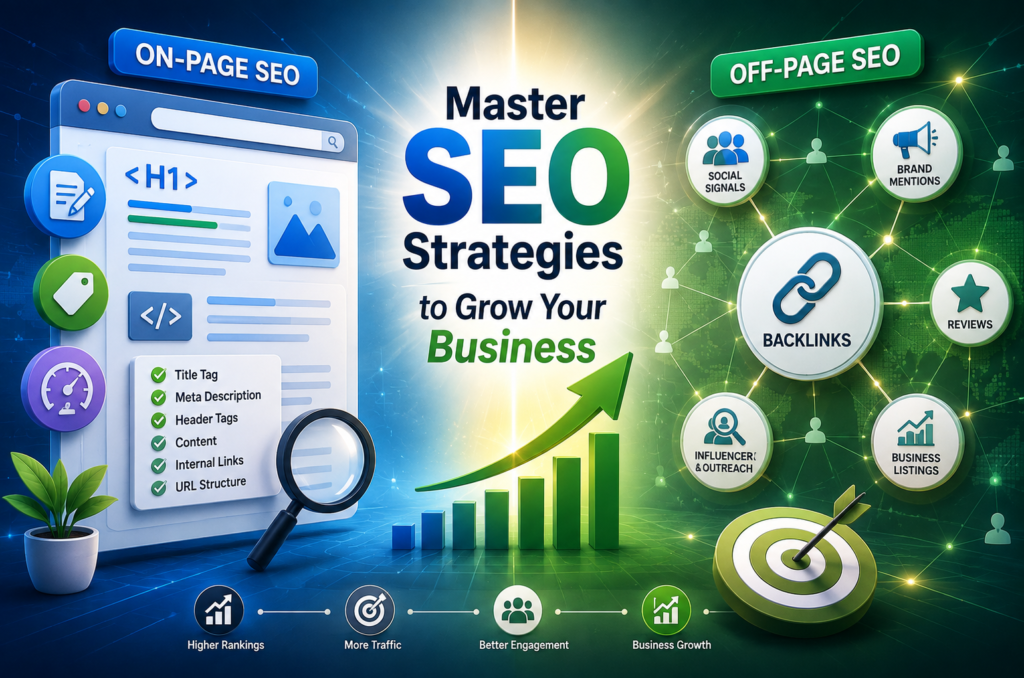
On-Page SEO and Off-Page SEO are the two essential components of a successful SEO campaign. While on-page SEO refers to the optimisation of web pages, off-page SEO refers to increasing your website’s authority through backlinks, mentions, PRs, and other external factors. It is important to understand the distinction between on-page SEO and off-page SEO for implementing a successful SEO strategy.
Introduction
Search engine optimisation (SEO) is one of the most important procedures that help companies increase their online presence and compete in the search engine results. Nevertheless, SEO does not consist of only one process but rather includes multiple processes that contribute to achieving higher rankings, authority, relevance, and user experience of the site. The two main parts of these processes are On-Page SEO vs Off-Page SEO, which cover various issues of search engine optimisation. On-Page SEO is the type of optimisation that takes place directly within the web page. The processes of On-Page SEO include creation of valuable content, keyword optimisation, title and meta description optimisation, heading structure, internal linking, image optimisation, URL optimisation, etc.
The first objective should be to ensure that each page is relevant, useful, accessible, and well-structured. However, Off Page SEO involves performing activities outside the website. Some of these activities include creating backlinks, getting mentions of the brand, doing digital PR, guest blogging, having a social media presence, and maintaining a positive reputation on the internet. Such actions help search engines realise that a particular website is credible and valuable in its niche. It is important to differentiate between these two SEO types in order to develop an effective digital marketing strategy. A website can have quality content and be technically optimised yet fail to attract traffic due to a lack of authority. Likewise, a website may be able to attract many backlinks, but fail to succeed if the website’s content fails to meet the search intent of users and deliver an excellent user experience. This article provides a comprehensive guide on On-Page SEO vs Off-Page SEO. We will explore how the two types of SEO are different from one another, the essential techniques involved, their benefits, pitfalls, and, more importantly, how the two methods can be combined together to form an effective SEO approach for businesses.
What is On-Page SEO?
On-Page SEO is the process of optimising individual pages to enhance their visibility on the search engines’ results pages as well as ensuring usability of the webpages. On-Page SEO includes different components which can be optimised by the website owners such as content, keywords, headings, URLS, title tags, meta descriptions and images among others. The primary aim of On-Page SEO is to enable the search engine to understand what the web page is about and if its content is relevant to the user’s search query. On the other hand, it needs to be optimised not only for the benefit of search engines but also for users themselves. For instance, if a company produces an article on digital marketing services, the page should be able to convey the meaning of the concept being discussed using the appropriate keywords, have a good title, proper heading structure and useful internal links. These changes will make the web page more comprehensible by both users and search engines.
However, On-Page SEO is not just about inserting the right keywords on your page. Today’s search engines look at many things, such as search intent, content quality, page experience, mobile usability and structure of the website, amongst others, when evaluating whether or not the web page can answer a user’s query.
Important Elements of On-Page SEO
There are several key elements of an On-Page SEO strategy. First, there must be high-quality content. The content on a web page must be unique, valuable, and accurate in answering the needs of the targeted audience. Also, it must be written more for readers rather than for the purpose of having keywords included.
Keyword optimisation is also an important element. Keywords that are relevant to the web page must appear naturally in certain parts, such as in the page title, main heading, introduction, subheadings, body content, and description of images where necessary. It is important not to use the same keywords too many times because it makes reading difficult.
Title tags and meta descriptions assist in defining the purpose of the page. For example, using a clear title would entice users to click on the search engine results, and the use of a meta description gives more information regarding the page.
Heading structure is another element to be considered. The use of headings such as H1, H2 and H3 gives a hierarchy and makes the article more readable. It also assists search engines in seeing the connection between the various segments of the content.
Some other elements are: SEO-friendly URL, internal links, image optimisation, mobile-friendly, speed and good use of image alt text.
Why On-Page SEO Is Important
On-Page SEO is important because it allows search engines to comprehend the nature and the aim of the page. No matter how good the products or services of the website are, the lack of optimisation can make it difficult for the search engine to understand the page content and relate it to the search queries. Proper optimisation can help improve user experience. With well-written content, appropriate headings, readable paragraphs, optimised pictures, and internal links, it will be easier for users to get information from the site. The positive experience can motivate them to spend more time browsing the site and visiting other pages. One more benefit of On-Page SEO is that it forms the basis for the rest of the SEO processes. For instance, getting backlinks to the page, which is badly optimised, will not bring any success since it cannot meet visitors’ search intentions. Finally, On-Page SEO can be seen as a continuous process rather than just a once-off activity. Changes keep coming on the part of search engines, competitors, and users. Constantly analysing and improving the content of the website is very necessary for businesses to survive in this dynamic world.
Definition of Off-Page SEO
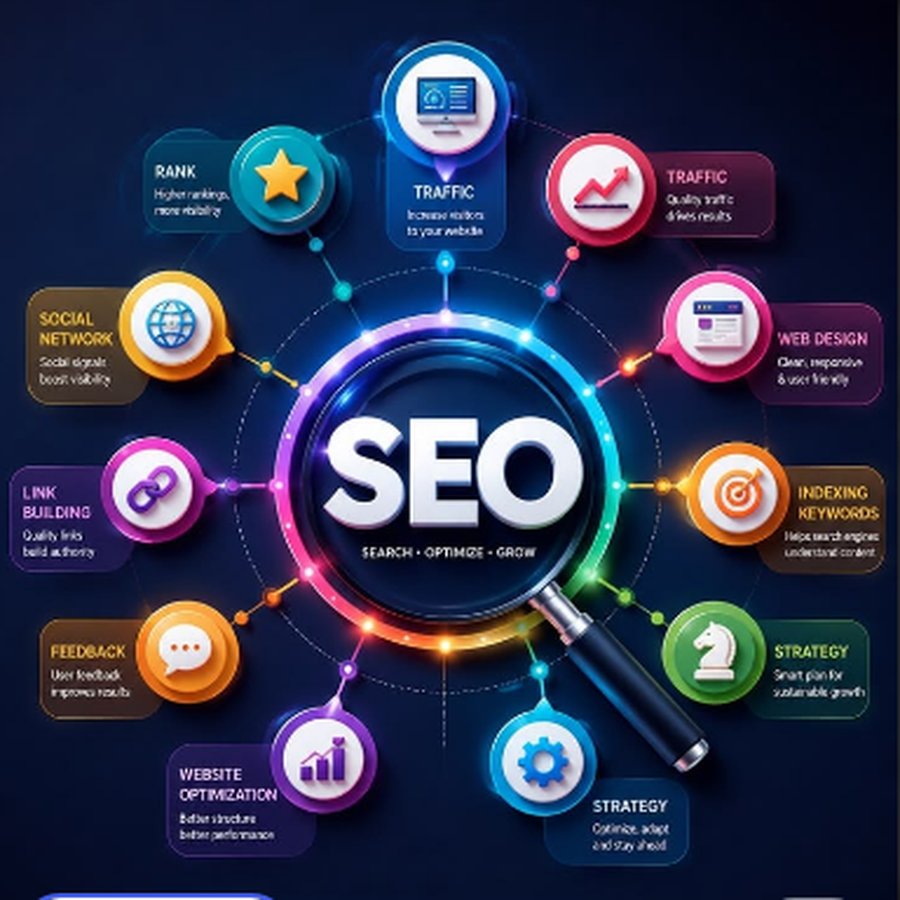
Off-Page SEO is the process of optimisation where optimisation is done outside the website to improve the visibility, authority, and ranking of the website on the search engine results page. In contrast to on-page optimisation, where emphasis is laid on issues such as content, keywords, headline, and internal links, off-page optimisation focuses on how the website is perceived by other sites or entities. Search engines take into account some external variables when rating the credibility and authority of the website. The more credible the site that links back, mentions the brand, or recommends the website’s content, the more credible the website becomes. One of the most identifiable features of off-page optimisation is link building. Backlink creation takes place when some other website has linked to your website pages.
Not all of the backlinks will be of equal significance. Links coming from a site that is related, authoritative, and trustworthy might have more weight than a link coming from an irrelevant or untrusted source. Off-page SEO can include activities like digital PR, guest blogging, branding, social media presence, review sites, influence connections, listing sites, and any other efforts to raise awareness for the website or its brand. The goal is not to just accumulate as many links as possible, but to create genuine authority and credibility in a certain area or niche. As an example, consider a digital marketing company writing a comprehensive guide about search engine optimisation. If respectable marketing sites use that guide as a credible source of information, search engines will notice that the material has some outside credibility.
On the other hand, these mentions will bring new audiences to the company as well as referral traffic. While many things that can be done on-site do not involve any relationship building, off-page actions usually require establishing connections with publishers, businesses, authors, journalists, and communities on the Internet. The results may take time since the authority of the website is built progressively. Regular efforts in order to produce high-quality and valuable content are usually much more sustainable than attempts to manipulate the ranking positions of the site. That is why the off-page SEO can be considered a long-term authority-building process.
Essential Factors of Off-Page SEO
Several processes make for an effective off-page SEO process. First and foremost, one should focus on creating backlinks from reputable sites in the same industry. Such links can serve as references linking your site with credible resources.
Link building is the process of getting links from external websites using valuable content, digital PR, resource pages, industry magazines, partnerships, and other legitimate channels. Quantity is never more important than quality. Few relevant links from reputable sites will do you more good than hundreds of irrelevant ones.
Digital PR and mentions are yet another essential factor in off-page SEO. Posting valuable content, research studies, expert opinions, and industry-related resources will make people talk about the brand and mention it in their articles even in the absence of any link.
Additionally, guest posting can be part of an off-page SEO campaign where the guest posting serves to provide value to the audience. Writing expert content and publishing it in credible industry blogs can serve to build credibility while giving room for referrals and linking.
Social media marketing helps expand the reach of website content. Social signals do not work to replace the traditional ranking signals, but the social platform can help the content reach journalists, creatives, companies, and people who can eventually use the content by referring or linking to it.
This factor is very crucial for companies targeting their operations towards their local clientele. Good reviews, proper company details, and brand presence will improve the level of trust and also contribute to local SEO.
The fourth important factor that needs to be included in off-page SEO strategies is building relationships. Relationships with industry experts, publishers, bloggers, business owners, and other relevant communities may help find collaborations and new pieces of content. This type of relationship is much more useful than link building as it provides long-term visibility. The best off-page SEO approach consists of different actions and not only the creation of backlinks.
Why Off-Page SEO is Important
Off-page SEO is important because search engines require signals other than website content for the evaluation of website reputation and authority. While a website may have good content and optimised pages, external validation helps build up the reputation of the site within competitive search results. Quality backlinks will be able to assist search engines in establishing relationships between websites and subjects. If authoritative and related websites cite a specific resource, the citation can be valuable information regarding the validity of that resource. Thus, obtaining high-quality links becomes an essential factor in any successful SEO campaign. Off-page SEO may offer additional advantages other than search rankings. Referral traffic can be obtained via a citation by a reputable publication, while a mention of the brand may introduce the company to people unfamiliar with it.
Therefore, the above activities can help not only SEO but also other aspects of digital marketing. Moreover, another important benefit of off-page SEO is related to the concept of brand authority. Whenever a company is consistently mentioned in reliable sources, takes part in industry conversations, has good reviews and references from websites relevant to its niche, it is likely that it will become better known within its industry. This can lead to brand recognition that can result in organic growth. Nevertheless, off-page SEO should never be seen as a numbers game. Buying poor-quality backlinks or engaging in suspicious link-building activities could cause more damage than anything else. In short, off-page SEO aims to build a reputation for your website away from the website itself. If done along with excellent content and proper on-page SEO, off-page SEO can be a crucial component of your SEO efforts.
On-Page SEO vs Off-Page SEO: Major Differences
It is very important to understand the differences between On-Page SEO vs Off-Page SEO because this is what is necessary to create a successful SEO strategy. While both these methods of search engine optimisation are aimed at increasing the online visibility of the website, they differ in the way they are done. On-page SEO means the use of those aspects that can be optimised on the website itself, while off-page SEO means the actions taken outside the website which affect its authority and reputation. A good SEO strategy cannot consist only of one method. There are many factors considered by search engines to assign ranks to the pages.
Content and Keywords
Content and keywords are some of the most critical factors while analysing the comparison between On-Page SEO and Off-Page SEO. On-Page SEO is primarily concerned with the content that appears on the website. This involves choosing appropriate keywords, understanding search intent, creating valuable content, optimising headings, and placing the keywords naturally within the web pages. For instance, if there is a business that wants to rank for “digital marketing services,” then the company’s website can create a page based on the same topic. The keyword can be placed naturally in the title, headings, intro, body text, URL, image alt texts, etc. This is not just about repeating keywords. Today’s SEO largely concentrates on relevance, usability, contextualization, and user intent.
The content needs to address user questions and offer sufficient information to meet user requirements. Off-page SEO operates quite differently. This is not an exercise of keyword optimisation on the webpage but helps in establishing the authority of the website through external factors. Backlinks from relevant websites, brand mentions, digital PR, guest posts, and other external factors will help Google realise that the website is authoritative in its niche. In summary, on-page optimisation regulates the way the page communicates about its subject matter, whereas off-page optimisation helps build authority outside the website.
Backlinks and Website Authority
The importance of backlinks is one factor that makes On-Page SEO and Off-Page SEO comparison very essential. A backlink refers to a link on another website that points to a page on your website. If the links are coming from reputable and relevant sites, it will be helpful in establishing the authority of your website. For instance, in the case of a technology firm, an editorial backlink from a reliable technology publication will prove to be useful. It is worth noting that not all backlinks have similar significance. Off-page SEO largely depends on external sites and individuals. An organisation may not fully control whether an external site or person decides to link to its site or talk about it. As such, building authority is a slow process since organisations have to continually produce high-quality content, build relationships, and present themselves as credible online entities before high-quality backlinks can start coming their way.
Control and Implementation
The third difference between On-Page SEO and Off-Page SEO is the level of control that one has with regard to implementation. This is because On-Page SEO affords a high level of control. For example, an enterprise can modify page titles, improve its content, tweak its headings, optimise images, improve internal links, improve its URL, and improve user experience. All these can be achieved with minimum dependence on another website. On the other hand, while a company can run campaigns to reach out to another website for backlinks and mentions, and discuss relevant issues in the industry, it cannot control another website from giving it a backlink or mentioning its brand. The distinction influences the way SEO marketing campaigns are handled. On-page actions are normally easier to plan and implement, while off-page initiatives involve building relationships and promotion. It is therefore important to monitor both of them separately, but manage them within one SEO campaign.
On Page vs Off Page SEO Short-Term vs Long-Term Effects
Finally, another important distinction between On-Page SEO vs Off-Page SEO is how the effect may be developed over time. On-page SEO changes may sometimes bring fast results, especially when a certain page already has some authority but is poorly optimised, structured or lacks clear search intent. Thus, improving the content, title, headings, internal links and aligning them with the search intent will allow search engines to better understand the page. But it is not enough for ranking to occur just because on-page optimisation took place. To create an off-page SEO effect, one needs more time. It takes time to gain good backlinks, increase brand awareness, build industry connections and become credible online. The best strategy for the business would be neither to select one SEO strategy nor to select another based on whether it is short-term or long-term.
On-page SEO could be used by businesses in order to build a solid base while using off-page SEO to enhance their authority on that base. In easy terms, on-page optimisation helps websites to become relevant and valuable while off-page optimisation assists in making the site appear credible and well-known.
Key On-page SEO Tactics
The concept of on-page SEO is all about optimising various elements on a website that will allow search engines to read and process the site and also assist users in navigating and consuming the content available there. In essence, good on-page SEO tactics will help search engines determine what a particular page is all about, what its relevance and purpose are, while making things easier for visitors. Contrary to off-page efforts, on-page SEO tactics are mostly under direct control of website operators.
Title Tags and Meta Descriptions
The title tag and meta description are essential parts of webpages that describe their content to search engines and to the people who may potentially visit the page. The title tag is displayed as the clickable heading in the search results and must describe the page itself by mentioning the main keyword in it. Meta description gives a brief description of the page. It is widely acknowledged that the meta description does not have any influence on the ranking, although it could possibly have an effect on the click-through rate if it correlates with the search term. Each page needs to have its own unique title and description.
URL Structure & Internal Linking
The URL structure must be simple for both readers and search engine crawlers. It should include short, descriptive keywords and have something to do with the page’s content. Numbers and parameters are not necessary. Also, it could become easier for readers to guess the content of the webpage by looking at its URL. Another important feature is internal linking. Connecting to pages related to the website enables the reader to easily navigate through your website and access more information. Additionally, the search engine crawler understands the relationship between those pages.
Content Optimisation and Search Intent
The creation of high-quality content lies at the heart of successful on-page SEO. It should meet the intention of a user’s search and not just repeat the keywords. Knowing what the search intent is enables one to create content that will solve a problem or make some decisions for them. Keywords can be used naturally in headings, in the introduction of the article, the body of the content, and other places, avoiding overuse. Some related concepts may help increase the topical relevance. The content must be structured properly by using proper headings, short paragraphs, bullet points, and examples. Adding new information where old and obsolete information is located and thickening up the thin content will add even more value to the page. The idea is not only to write a long page but to create valuable information.
Image and Technical Optimisation
While images can enhance engagement and explain complicated information, they have to be optimised accordingly. Using descriptive file names, alternative texts that make sense, correct image size, and compressing files will help to make the process of image usage more accessible and efficient. Inefficiently designed images can slow down the site, making the experience for users worse. Technical aspects of the site optimisation also contribute to on-page SEO. Businesses have to focus on such factors as mobile responsiveness, page speed, crawlability, indexability, proper use of structured data and HTTPS. Technically well-designed websites provide the best environment for search engines to explore and understand their content. When all these methods are used, on-page SEO will not be just an addition of keywords to web pages. The method will create a clear link between search intent, useful content, site structure and user experience. The base will allow applying off-page SEO practices.
Significant Off-Page SEO Tactics
The term off-page SEO describes optimisation measures that are taken outside your website in order to raise your website’s authority, credibility, visibility, and rankings in search engines. On the contrary, on-page SEO deals with content, keywords, the structure of the website, as well as user experience. The role of off-page SEO is to give the search engines an idea about how credible and useful your website is compared to other sites. The use of off-page SEO techniques will help to create referral traffic, boost brand awareness, and improve the reputation of your website. Unlike on-page SEO, off-page SEO greatly depends on how others perceive your brand.
Building Links
Building links falls under one of the key elements of off-page SEO methods. This refers to having links that come from other reputable websites that lead to your website. If you have links from reputable websites, the search engine may regard such links as showing that your website has information that is valuable and reliable. However, all backlinks do not have the same value. Having links from reputable websites within your industry is much more valuable than having several links from other irrelevant websites. Organisations should therefore focus on getting relevant backlinks. There are various methods that can be used to build good links. Original research, guides, statistics, infographics, case studies, and expert information may attract the interest of other websites for linking to your website.
Backlink quality and relevance are much more important than the number of links. Websites must not indulge in purchasing too many backlinks, getting involved in any kind of link schemes, or even in generating backlinks artificially. A healthy backlink generation strategy must be focused on relevance and relationships.
Social Media and Brand Mentions
Social media is not just about promoting one’s product on the internet but can also be used indirectly to have a successful off-page SEO strategy. Posting useful content on social networks like Instagram, Facebook, LinkedIn, YouTube, and others will help make content more visible and get more chances for people to see and mention your website. The moment people start noticing the content on social networks, there will be a chance that the content is seen by bloggers, journalists, industry representatives, influencers, and even customers. Also, brand mentions matter a lot. Despite mentioning a website without providing a link to it, mentioning a business entity repeatedly can have a positive impact on building its online identity and awareness.
Providing consistent business information, social content that is valuable for customers, interaction with them, and being part of online communities can build brand awareness. Businesses need to concentrate on creating content that will be shared by users willingly. Educational articles, insightful posts, short videos, findings from research, industry opinions, and tips can attract more attention than promotional content alone.
Guest Posting and Digital PR
Guest posting is when one creates high-quality and unique content and places it on external websites. If it is implemented properly, the above-discussed approach will enable companies to attract new customers, share knowledge and experience, build relations in the industry, and even earn some backlinks. It should be admitted that the key point in the process of guest blogging is its relevance and quality. One needs to write something beneficial for the readers of the website, not just to get the link there. It is necessary to choose only high-quality websites that have some connection to one’s business or audience. With digital PR, one uses information, expert opinions, research, insights, and valuable resources that would attract the attention of the online media.
An example is conducting industry research or writing down an opinion about a certain trend. The information can be used in the journalists’ or publishers’ articles. These two marketing strategies prove effective especially if there is high-quality content on the corporate website to support them. The external audience must come across relevant content on the company’s site once it becomes aware of the brand through any other means like articles or media coverage.
Local SEO and Online Reputation
Local SEO is another key factor in off-page optimisation for companies that operate in geographic locations. Having proper information about the business on all related online directories, business pages, review sites, and local websites can help in boosting local visibility. Proper information like the business name, physical address, contact number, website, and operating hours helps customers and search engines to know the business. Businesses must ask their genuine customers to provide them with reviews, whether good or bad. Online reputation plays a vital role in creating trust. A good reputation can be gained by positive reviews, customer experiences, industry citations, community participation, and appropriate brand communications. Thus, in order for local businesses to implement off-page SEO tactics effectively, the approach to building backlinks needs to go further and include other activities. In the end, off-page SEO involves creating trust rather than attempting to manufacture it artificially. Companies that can create useful content, forge real connections, receive high-quality mentions and have a good reputation online will be able to create long-term search visibility.
On-Page SEO and Off-Page SEO
There are two vital components that ensure a successful SEO campaign, namely On-Page SEO and Off-Page SEO. On-Page SEO refers to the optimisation of internal factors of a website, while Off-Page SEO refers to the increase in the website’s authority and reputation outside the site itself. Although being two separate techniques, they can work effectively when used together. Well-optimised websites with high-quality content may fail in the search results if their authority level is poor, while websites with good backlinks will be unsuccessful if their content does not meet the needs of the users. There are many criteria that search engines consider when selecting webpages for the search results. On-Page SEO allows the search engines to understand what each webpage is about and whether the content is worth its place in the search results. Off-Page SEO makes it possible for search engines to check the authority of the website and the relevance of its content.
Steps to Develop a Balanced SEO Strategy
A balanced SEO strategy starts from solid On-Page SEO work. Before you spend a lot of time building links, engaging in digital PR and other promotional efforts, you should ensure that your website offers a good user experience. It means developing useful and unique content, doing keyword research, optimising title tags and meta descriptions, working on internal linking, proper structuring and navigation. It is important to use the results of your keyword research while developing your content strategy. Rather than trying to repeat some target keyword, you need to understand what the purpose of the query is for users. The page needs to answer all their questions and provide relevant information. After creating an On-Page SEO base for the website, Off-Page SEO could be used to build the website’s authority.
Backlinks received from other authoritative websites would show that the content was valuable to other sources. This goal could be achieved via natural guest posts, digital PR, mentions, partnerships, and content promotion. These two components should also complement each other. For example, the company could publish an industry guide on its website and use outreach and digital PR for promotion of the guide. Other websites might then consider the resource valuable and include it in their content, linking to the page from where it came. The higher authority would enable the page to compete for more valuable keywords. The SEO strategy should, thus, go through a continuous loop, which involves researching user needs, creation of valuable content, website optimisation, promotion of useful resources, gaining mentions, tracking performance, and adjusting the strategy accordingly.
Integration of Content, Authority and Trust
Content, authority and trust are highly interrelated aspects in SEO. Quality content attracts customers to a site, whereas authority makes a site stand out in the crowd. Trust makes the visitor believe in the content, service or product that is being offered. On-page SEO concentrates on the content and user experience side of the equation. Properly structured and informative content, accurate details, relevant keywords, clear headings and useful internal links make the navigation easy and more effective. Off-page SEO focuses on the authority aspect. The mentioning, citation and linking by quality sites to a certain company can add value to the overall credibility of the company online. But the emphasis should be on building reputation and not accumulating links.
As another example, a software development company may provide a comprehensive article on the process of developing and launching an app. The article can be optimised by the company for particular queries and be linked to the corresponding services page from the site internally. Then the guide will be promoted to tech-related sites, business resources and industry forums. In case some influential sources find this resource interesting, they may refer to it. It clearly shows why Off-Page SEO and On-Page SEO should not be viewed as totally different marketing practices. On-Page SEO ensures the creation of a resource worthy of discovery, while Off-Page SEO allows building the authority necessary to compete for rankings in SERPs.
Common On-Page SEO Mistakes
On-page SEO is a significant component of understanding and ranking by search engines. Nevertheless, mere keyword insertion and optimisation will not necessarily result in a better ranking for websites. Ineffective methods of optimisation will result in poor visibility, bad user experience, and can even affect the credibility of the site. Therefore, companies must focus on creating content that is both relevant and optimised without trying to influence search engine rankings.
Keyword Stuffing
Keyword stuffing is one of the most common mistakes made in on-page SEO. This technique involves the unnatural repetition of a keyword throughout the web page in order to influence its ranking. Search engines are more efficient at identifying topics, context, and intentionality. It would be better to create content with the use of the keyword without necessarily repeating the same keyword all the time. The keyword must be well-placed in areas such as the title, opening paragraph, heading, URL, and others. It would be much better to create content that would serve the interest of the readers even before optimisation is carried out. If, for example, there is a sentence which cannot make sense because of the presence of the keyword, then the sentence should be rephrased.
Lack of Value in the Content and Bad User Experience
The other mistake that websites make is to publish content that offers little benefit to users visiting the website. Even if there are keywords and good technical aspects of the web page, it is unlikely to perform well because it fails to answer the user’s query of the user. Content such as thin content, repetitive information, bad headings, long paragraphs, and old content can lead to a bad user experience. There is a connection between user experience and on-page optimisation strategies. Users need to be able to scan the web page effectively and find the necessary information from the web page without much trouble. Businesses must refrain from producing a large number of pages that cover the same subject matter without any objective. This will make it hard for search engines to decide which page should rank for the specific query. The ideal strategy would be to produce content that is both original and relevant to the searcher’s intent. You need to ask yourself before publishing your web page if the page helps answer the visitor’s question and provide better information and experience compared to its competitors.
Which one is better? On-page or Off-page SEO?
In considering On-page SEO vs. off-page SEO, there is not always one thing that would be more important than the other. There is a separate way for each type to contribute towards improving the visibility, authority, ranking, and natural traffic of the site. The major difference between on-page and off-page SEO is that On-page SEO involves optimising things directly on the site, while Off-page SEO is used to help build authority and reputation from other places apart from the site. Despite a website having great content and good optimisation, it would not rank well enough when the competition is high without any authority at all. At the same time, despite having many backlinks, the site will not do very well because of its poor page content and bad user experience. Therefore, businesses need to see on-page and off-page SEO as complementary and not competing techniques.
When Is On-Page SEO Necessary?
On-Page SEO must be made a priority in case something is wrong with the website, such as weak pages, outdated pages, or low-quality pages. Before any effort is made to link externally or promote the website in any other way, it should first be ensured that there is some high-quality content. Here is a list of On-Page SEO elements that should be addressed: titles, headings, URLs, content structure, internal links, images, and keywords. The content should also correspond to the intent that the person searches for in the query. If users have problems finding useful information on the site, just having external authority might not work effectively. On-Page SEO becomes necessary in case of a newly created site, in case a site redesign is required, or if a company does not have experience in conducting an SEO audit.
In addition, working on improving existing pages can become quite efficient in terms of enhancing organic search. The second reason why On-Page SEO should be taken seriously is because of control. The website owner is in a position where he can directly modify his content, the structure of his page, metadata, internal links, etc.
Conditions Under Which Off-Page SEO Should be Given Priority
Off-Page SEO becomes highly significant in cases where a website has a technical SEO setup, quality content, and a well-built SEO base with optimised pages. In cases where competitors have higher authority compared to your website, despite offering content with equal quality, Off-Page SEO could help you become more competitive. An essential part of Off-Page SEO would include building quality backlinks from reputable websites. Such backlinks help the search engine get an idea of what other websites think of your page. Off-Page SEO may even help existing enterprises looking to boost their brand recognition. Industry mentions, brand citations, digital PR, partnership marketing, local listings, and guest posting will help a brand to increase its presence outside of its website.
Nevertheless, companies should keep in mind that quality outweighs quantity. Having many unqualified or irrelevant links will not bring any good and may also put an enterprise at risk. Therefore, the most successful Off-Page SEO will have to be relevant, focused on building authority, acquiring links naturally, and developing genuine connections. Thus, the most appropriate option would be neither On-Page SEO nor Off-Page SEO. A good SEO strategy starts with building an optimised website and content, then proceeds with establishing authority using trustworthy external sources.
On-Page & Off-Page SEO Practices in 2026
Continued development of SEO is inextricably linked to the further development of search engines regarding their ability to analyse content, understand user intent, evaluate websites and measure domain authority. For any business to be able to maintain its search visibility in 2026, it cannot depend on placing keywords only. Any good SEO strategy must have elements of both On-Page SEO and Off-Page SEO. Current search engines increasingly assess whether a site is able to satisfy what users want. That way, businesses will need to concentrate on creating valuable content instead of using some techniques that are intended just for manipulating search engine rankings. Besides, external factors such as backlinks, mentions, digital PR, and online reputation can improve the credibility of a website.
Building a Sustainable SEO Strategy
A sustainable SEO strategy starts by knowing the audience and what they want. Apart from choosing keyword phrases that receive many searches, companies should be aware of the queries and problems and possible solutions of their audience during online searches. That way, they will make sure that they create useful pages. In relation to On-Page SEO, companies have to optimise different aspects such as title, headings, URL, internal links, images, and content structure. The keyword phrases should appear naturally on the page content without repetition. The pages should be navigable and compatible with computers and mobile devices. Content quality should remain the most crucial. Companies should keep optimising old content, deleting thin pages, consolidating repeated articles, and creating rich content related to important topics.
Posting consistently is wonderful, but posting lots of useless content is not practical. Off-Page SEO would need to support these initiatives. Rather than seeking backlinks from websites that have nothing to do with the subject matter or are of low quality, companies would have to work hard at acquiring links from authoritative sites. Patience is another aspect of a sustainable approach. SEO is usually a marathon-type activity and not a sprint. Companies need to constantly monitor their performance, find areas for improvement, enhance their existing content, etc.
SEO Performance Metrics
It is important to measure the performance of SEO because you need to know if the SEO strategy is providing any real results. Ranking is a good measurement, but it does not have to be the only one. Just because a website ranks for certain keywords does not mean that it brings any value to the business. Traffic metrics are one of the metrics that can be checked in order to track the performance of the SEO efforts. Companies can track how many people visit their website through search engines and what pages they go to the most. Keyword visibility is yet another helpful measurement tool. Checking up on relevant target keywords may indicate whether the website is gaining visibility for the relevant keywords. Businesses must pay attention only to the relevant keywords and not try to rank for any keyword just for the sake of ranking.
Metrics for engagement may be helpful as well. Time spent on pages, engagement, returning visitors, and navigation behaviour may help understand whether the users found the content interesting. Conversion metrics become extremely important for business-oriented websites as the primary objective of such sites is to obtain an inquiry or make a sale. In relation to Off-Page SEO, companies could measure the quality and relevance of the referring domains, number of backlinks, brand mentions, and digital PR. Less might actually mean more in terms of the number of links. Through consistent reporting, the company will be able to identify trends and make informed decisions.
Instead of making a lot of changes because of short-term fluctuations in rankings, they should monitor SEO activity for a longer period of time and work on changes that will help them achieve sustainable visibility, traffic, authority, and conversions. With the combination of good On-Page SEO, proper Off-Page SEO, quality content, technical adjustments, and performance monitoring, businesses will be able to create a strong search presence in 2026.
Conclusions
On-Page SEO and Off-Page SEO are both important elements for any effective search engine optimisation technique. The difference between them is that while On-Page SEO concentrates on website elements, Off-Page SEO builds the authority of the website, its reputation, and credibility on the Internet. Any SEO strategy can afford to consider On-Page SEO and Off-Page SEO separately; they need to be combined in order to enhance rankings, drive qualified traffic and establish online presence. Firstly, any company needs to create valuable and properly structured content, and optimise all necessary website components, such as title tags, headers, URLs, internal links, images, page speed, etc. Having established this groundwork, Off-Page SEO efforts like link building, digital PR, brand mentions, guest posting, and local outreach can help build the authority of the website.
For those companies that are looking to improve their online performance, it would be advisable to hire SEO professionals who will implement a strategic and measurable approach to SEO optimisation. Madhura Technologies, based out of Coimbatore, works with companies to develop an appropriate marketing strategy for digital marketing. The success of SEO does not consist of choosing either On-Page SEO or Off-Page SEO. It consists of merging both types of SEO, determining whether they are effective, making changes, keeping oneself abreast of search engines, and providing proper information to visitors.